Langenargen, Germany (15 May 2013): Part boat show, sponsor exhibition, picnic, food and music festival, with one of the nation’s largest sailing events attached, Match Race Germany sets sail tomorrow, the opening stage of the Alpari World Match Racing Tour 2013. 12 international teams will be competing off Langenargen on Lake Constance with the snow capped peaks of the Swiss and Austrian Alps as a backdrop.
One of the rising stars of whom great things are expected this season is US Virgin Islands sailor Taylor Canfield and his USone team. Canfield, 24, won both the Argo Group Gold Cup in Bermuda last year and then the season’s grand finale, the Monsoon Cup. He joins the Alpari World Match Racing Tour this season as a first time Tour card holder.
Canfield attributes his recent success mainly to his position as Sailing Director of the Chicago Match Race Centre. “That has allowed me to use the boats and just be around match racing non-stop, doing everything from sailing to coaching and umpiring. I have just been sailing all the time.”
Of his approach, now he is a Tour Card holder, Canfield says: “I guess there will be a bit more pressure, but we are going to go into it with level heads and will sail in the casual way we always have, taking one race at a time. You can’t really sweat the small stuff if you lose a race. Hopefully we’ll come in swinging.”
However he acknowledges this is his first time at Match Race Germany, sailing on Lake Constance in the Bavaria 40S.
At the opposite end of the age spectrum is Polish veteran match racer, America’s Cup helmsman and Match Race Germany wildcard, Karol Jablonski. The Match Racing World Champion in 2002 (on his 40th birthday), Jablonski says he is back because can’t stay away. “Match racing is like a drug for me, but in a positive sense. Match racing is the way of sailing I love - that’s why I am here.”
He believes his entry was accepted in order to ‘mix things up’. “Maybe I have an aggressive style of sailing, so I bring some more action into the game. Sometimes the young guys are thinking too much and you have to show them some things they have never done.” So expect some plain old fashioned aggressive match racing – although Jablonski acknowledges that there is a hefty damage deposit on the boats being used here.
German eyes will be on National Match Racing Champion Sven-Erik Horsch and the young blade Philipp Buhl. “Philipp is one of the biggest talents we have in Germany,” says Match Race Germany organiser Eberhard Magg, of the Laser sailor who has in the past been ISAF ranked #2 in the world in the Olympic singlehander.
Buhl is sailing mainly with fellow German Olympic sailors, but has some big boat experience in his crewman Mikael Seifarth. As to his match racing record, Buhl admits: “I have almost none. I’ve done three match races in Lasers, which are a bit different to these boats! But we have an international juror in Germany who knows about match racing and I asked him to talk me through it. Theoretically I know 80% of the moves, but doing it on these boats and sailing against the pros isn’t going to be so easy.”
Realistically Buhl doesn’t believe he will make it past the qualifying round. “Today in the training we saw that even in 5 knots when it is really calm and you have time in the manoeuvres, it was not too easy for us.”
For Eberhard Magg, this is the 16th Match Race Germany he has organised and he is looking forward to the start of the competition tomorrow. “We have a new generation of match racers here,” he says of the competitors. “It is a great line-up and anyone can win. There is no clear favourite at the moment.”
While conditions have been benign this afternoon, Magg anticipates that tomorrow with a depression over Italy the weather could be very different.
Over the next few days crowds will start gathering before the big numbers arrive over the Whitsunday bank holiday weekend. “They come because it is a different type of festival,” says Magg. “The Germans are known for beer festivals with the big steins and OOM TA-TA. This is different, with different food, not just the red sausages and fries and there are nice places to spend your time.”
There is plenty of things to do for families while Porsche World is popular with children and last year had queues of more than 100m. Bands are playing free concerts every night while on Friday there is a ‘typical Bavarian night’. Throughout there is commentary from leading German TV sports presenter, Nils Kaben, while Magg has set up other projects such as the venue becoming a trial horse for 4G, offering lightning speed internet for those with suitably enabled mobile phones.
El Puerto de Cartago es una de las construcciones más espectaculares de la antigüedad y podría ser considerado como la octava maravilla del mundo antiguo sin que desentonara en absoluto con las otra siete. Sin embargo, incomprensiblemente, su existencia es apenas conocida por el gran público y su “popularidad” dista mucho de estar a la altura de Los Jardines Colgantes de Babilonia, El Coloso de Rodas o el Faro de Alejandría por poner algunos ejemplos.
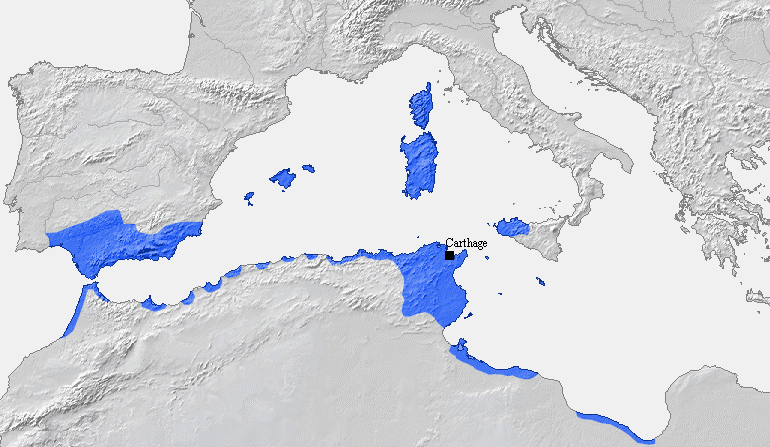
Cartago, fundada por los Fenicios y situada en lo que es la actual Tunez, fue una de las más importantes ciudades de la antigüedad y prueba de ello es que los romanos mantuvieron hasta tres guerras con los cartaginenes(Guerras Púnicas), entre otras razones, para arrebatarles la aplastante hegemonía que mantenía la flota de Cartago en elMediterráneo.
Los Fenicios fueron durante siglos los dueños absolutos del mar y tanto comercial como militarmente sus naves y marinos no tuvieron rival. En los momentos de mayor apogeo su armada llegó a disponer de más de 300 barcos la mayoría de ellos Quinquerremes, formidables barcos de guerra con cinco filas de remeros.
Interpretación (quizás poco viable) de un Quinquerreme.
Este inmenso poderío naval y comercial necesitaba un centro de operaciones a la altura de las circunstancias y como la ubicación de Cartago era perfecta y dinero no faltaba, los cartagineses construyeron el puerto más asombroso que haya visto el mundo antiguo.
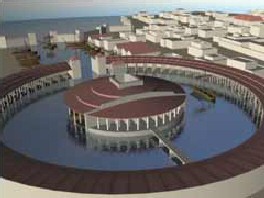
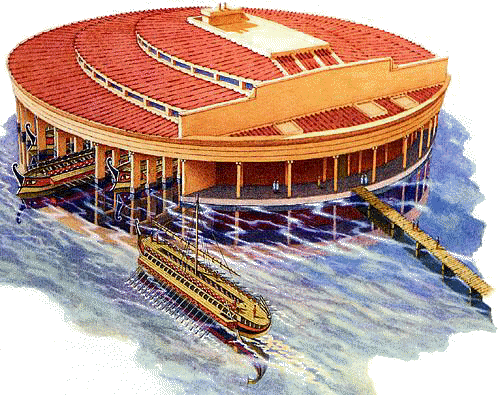
Perfectamente fortificado y protegido, el puerto de Cartago podía albergar hasta 220 grandes barcos en donde podían realizar segura y cómodamente todas las operaciones de carga, descarga o reparaciones que fueran necesarias tanto para buques de guerra como mercantes.
Pero como ya saben algunos de ustedes prefiero, siempre que es posible, dejar que lo cuente alguien que fue testigo (casi) directo de la historia. En este caso se trata de Apiano, autor del siglo IIa.C. y que basó su descripción en un testigo directo de la caída de la ciudad.
Los puertos de Cartago estaban dispuestos de tal modo que los navíos podían pasar de uno a otro; accedían desde el mar por una entrada de unos 21 m de anchura, la cual se cerraba con una cadena de hierro.
El primer puerto (zona rectangular), reservado a los mercantes, estaba provisto de numerosos y variados amarres. En medio del puerto interior había una isla. La isla y el puerto estaban bordeados por grandes muelles.
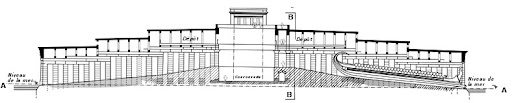
A lo largo de estos muelles había hangares, que podían albergar 220 barcos de guerra, y sobre los hangares se levantaron almacenes para los aparejos. Delante de cada hangar se elevaban dos columnas jónicas, que daban a la circunferencia del puerto y de la isla el aspecto de pórtico.
En la isla se construyó un pabellón para el almirante, y de dicha construcción partían las señales de las trompetas y las llamadas de los heraldos. Desde ahí, el almirante ejercía su vigilancia.
La isla estaba situada enfrente de la entrada y se hallaba a mayor altura: así el almirante veía lo que ocurría en el mar, mientras que los que llegaban de más allá no podían distinguir con claridad el interior del puerto.
Los arsenales eran invisibles incluso para los barcos mercantes: éstos estaban rodeados de un muro doble y dotados de puertas, las cuales permitían a los mercantes pasar del primer puerto a la ciudad sin que pudieran atravesar los arsenales.
Hay que decir que los hallazgos arqueológicos confirman casi en su totalidad el relato de Apiano.
A continuación, en este vídeo, pueden ustedes ver una reconstrucción virtual.
[Vídeo]
Finalmente en al 146 a.C. y tras tres guerras Púnicas, Cartago fue conquistada por Publio Cornelio Escipión Emiliano. La ciudad fue arrasada no dejando piedra sobre piedra (literalmente) y abandonada con la intención de que aquella ciudad, que se atrevió a desafiar hasta tres veces a Roma, desapareciera para siempre de la faz de la tierra y de la memoria de los hombres.
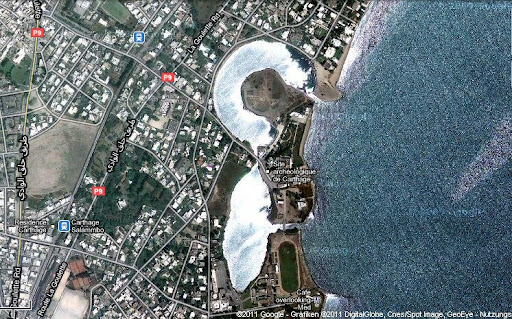
Aspecto actual del puerto de Cartago. Desde el aire aún se diferencia el puerto mercante y el militar, la parte redonda.
Sin embargo, su estratégica situación era demasiado valiosa como para que fuera desperdiciada y fue el propio Julio Cesar en persona quien ordenó que se levantará allí otra ciudad, fundándose al poco tiempo Julia Cartago y reconstruyendo, con algunas variantes, el puerto más formidable de toda la antigüedad.
Film retraçant les meilleurs moments de la 4eme édition des Voiles de Saint-Barth.Les plus beaux voiliers des Caraïbes, des Etats-Unis mais aussi d'Europe ont répondu présent. Les équipages chevronnés et légendaires souvent issus de la Coupe de l'America ou de la Volvo Ocean Race ont sut animer le plan d'eau entre les îles paradisiaques. "Un opus exceptionnel" affirme François Tolède, organisateur de l'épreuve, l'enthousiasme communicative envisage déjà un 5ème anniversaire en 2014.
SailingNewsTV est la première chaîne Youtube sur la voile : course au large, croisière à la voile, apprentissage, voyages, découverte et tests des bateaux.
Welsh Nationals 2026
-
New champions were crowned at the Puravida-MiPost Welsh National Surfing
Championships 2026 at Freshwater West last weekend.
The post Welsh Nationals 202...
Kalsarikännit
-
Learned a new word today.
Kalsarikännit! Yup, - that's it.
What an amazing word.
Need to practice that.
I hope you are all well... in Second Life.
X...
Leonard Nika en Portugal
-
Todos tenemos un sitio al que solemos volver para coger olas fuera de
nuestro spot habitual. Ese sitio que no nos queda cerca de casa pero que
siempre qu...
The Mystical Runa
-
We at Trudeau Yachts are always looking for the next inspiration. This one
came from within Second Life itself. It turns out a close SL friend of
Jacquelin...
VIAJE AL MAR ROJO ESPECIAL PECIOS (7 OCTUBRE 2017)
-
Estimados amigos: Os hago llegar informacion sobre viaje al Mar Rojo que
tenemos previsto realizar junto con varios amigos ESPECIAL PECIOS, con
salida el 7...
Cementerio de barcos: los barcos mejor conservados
-
Dentro de la región del noreste de Estados Unidos, en Michigan, nos
encontramos con con uno de los santuarios subacuaticos más espectaculares
de barcos.
...
When Should Children Get Their First Cell Phone?
-
Cell phones can be powerful tools. The most notable of those features is
the ability to call someone in the event of an emergency. This has led to
children...
Whole Sim Rental Controller - Large is sweet!
-
While parcels of rental business are growing big, so are the appetite of
Second Life residents. More and more tenants begin to look for parcels that
are be...
Summer Fun - Go take some!
-
It has been a while since I have built products and this is mainly because
- I kinda built everything :)
If you pop over to Weston Marina - Boogdolt Sim St...
Good bye, and thanks for all the fish.
-
Sometimes it takes us humans quite some time to admit something to
ourselves that we don’t want to admit, but eventually there’s no more
putting it off. It...
VIDEO: Programme Seven 2014, Sydney, Australia
-
The Sydney Harbour Bridge and the world famous Opera House provided the
iconic backdrop to the final of the 2014 Extreme Sailing Series™. After 11
month...
Virginia E. Johnson, 1925-2013, sexóloga
-
Originalmente publicado en Sexología en redes sociales:
Versión imprimible [This article is also available in English in Sexology
101, Virginia E. Johnson,...
Gallery Shop has moved and Shows today!
-
Sadly Aaakriti Arts has closed (more in the next post) and the LTD Gallery
had to be moved. For now, I just moved the displayed art of the last LD
issue ...
LCC Sunday Cruise
-
So this was the LCC Sailing cruise that took place on Sunday 12/8/13.
A few of the RM boats took part.
GUNPORT to VYZMANAVIN
I was snowbound and unable to ...
Eta Viva
-
Buy Now from the Second Life Marketplace !!! The Eta Viva is a beautifully
crafted mesh speedboat with warm wood textures, brass fittings and
sumptuous lea...
Thank You!!
-
Thank you for an incredible four days of sand, sun, and sea! We had such a
great time, and we couldn’t have done any of this without you. To our
amazing ve...
Spunky Stripper Pro-Tips
-
Spunky Stripper Pro-Tips If you want to protect hair, prim feet, tattoos or
another other items, in general, against RLV traps and strippers, simply
place ...
Design 90 - 76'-6" Shoal Draft Schooner
-
Only two drawings were prepared for this preliminary design proposal; a
Lines Plan and a Sail & Deck Plan. I believe the Lines Plan that is shown
here i...
Finishing up a new Duo feature
-
I’m just about to release a new feature for the Duo models that will allow
dance hosts to do something not currently available in any other couple
dance sy...
VCC 82™ release Saturday 25 11 am sl.
-
Press release: Vuitton Cup Class 82™ To be Released this Saturday 25 11:00
AM SL. Place :New Golden Gates Yacht Club and World Sailing Center . Home
of SL ...
Accesos a Marina Valencia Sailing Club
-
El acceso a Marina Valencia Sailing Club, está enfrente del famoso edificio
veles i vents, se entra por la Darsena Sur, si tienes alguna duda os
ponemos u...